WHAT IS HAIRWORK
Hairworks exerts a strong emotional connection and sentimental influence on his/her beholder.
Hairwork pieces go way back in history, but the great period of manufacture of these artefacts were the 18th and 19th century. The popularity truly reached its apex in the Victorian era, where the techniques were at their peak in details and diversity. Hairwork frames and jewelry as well as accessories were highly popular. The demand was so high that at some point, it even became a fashionable wearable item, losing its sentimental value. It was all the rage for a while - but fashion comes and goes.
The true essence of hairwork remained, as people still felt the urge and need to own an everlasting token of love, attachment, friendship or remembrance. With the rise of popularity of photography, and WWI, it unfortunately became less prevalent, up to being almost entirely forgotten.
Hair is a rot-proof material, it was therefore the perfect way to keep a loved one close, for sentimental reasons as well as mourning. It holds a strong emotional impact. For instance, mothers would keep a lock of their child’s hair, lovers would exchange hair as a token of their affection, and family would keep hair from a departed member, to honor and perpetuate his/her memory. At a time when photography either did not exist, or was not widespread, it allowed people to keep a tangible souvenir.
Nowadays, we are a handful of passionates reviving one or several of the many forms of hairwork (see hairwork classification below). Wirework and table work being the most “common” ones. The popularity of historical movies and series adaptations seem to be increasing its renewed interest as well, such as Wuthering Heights by Emerald Fennell (2026), or even Bridgerton, dropping some hints of hair jewelry in the fourth season.
We generally classify hairworks in different categories:
-
Palette work (aka flatwork)
-
Sepia work (is sometimes considered as a subclass of palette work)
-
Wirework
-
Table work
-
Palette work
Hair could be quite short for this technique.
Usually in 2D, but 3 dimensional designs could also be achieved.
It was laid down and glued flat, then cut into shapes. The use of chopped hair was also common in palette work.
It was then arranged in various designs such as floral patterns, cemetery or mausoleum scenes, for instance. The pansy flower was highly widespread, as the French word for it is “pensée”, meaning “thoughts”, which was therefore highly symbolical, as a sign of attachment or mourning. Creativity was the limit, so there is a very wide diversity of pieces.
The making of curls was also highly popular. Once again, different techniques were used to achieve different types of curls. It could be keeping the ringlets of a child, or making thick curls, stuck directly on the background (usually either glass, ivory, mother of pearl, galalith or paper). The most well known curl being the Prince of Wales - a distinctive curl, holding its round shape while being laid flat. It was most commonly used in jewelry such as pendants or brooches.
(See illustration photos at the bottom of the page)
-
Sepia work/painting
Hair could also be quite short for sepia work.
Was often found on smaller scale pieces, such as medallions or brooches. Hair was pulverized (either very finely chopped or reduced to powder) and added to water and adhesive to form a brown pigment. It was used to create classic sceneries, almost exclusively related to death and mourning.
On a bigger scale, sepia work was often used combined with palette work, for writing or adding some details.
(See illustration photos at the bottom of the page)
-
Wirework
Hair definitely needed to be longer for this technique, usually around 12 cm (5 in).
Hair flowers were created by wrapping hair with wire around a rod. Many different wrapping techniques existed, which allowed to create a wide diversity of flower bouquets and wreaths. It could even be shaped into birds or elements such as acorns for instance. The final pieces usually lay in beautiful shadowbox frames, or even sometimes under glass domes.
(See illustration photos at the bottom of the page)
-
Table work
Hair needed to be longer, if not the longest among all of the hairwork techniques (at the very least 15 cm (6 in) usually).
With the help of a special table with a hole in the center, hair is woven into intricate patterns, using bobbins and weights. Similar to lace making in a way.
Table work was known to make beautiful and unique pieces of jewelry such as rings, bracelets, watch chains, and so on.
Hair needed to be prepared first, in order to get stretchy. It could also be boiled and baked at the end in order to give a special shape to the woven piece.
(See illustration photos at the bottom of the page)
Usually crafted by skilled and renowned artisans (sometimes even hairdressers), hairwork also became popular among Victorian women. Instructions and patterns were available in various Lady’s Books or magazines, as a pastime (especially in the US and England). Wirework was, in fact, almost exclusively made by women at home. Table work was also popular among them. We sometimes come across examples of homemade palette works. I must say, they are always very touching. As we see the deep bond and devotion which was put into their confection, which definitely makes up for the possible lack of skill or technique.
I personally specialize in palette work - flat or in 3D - with the additional use of chopped hair, sepia painting techniques as well as braided hair (not requiring table work). I also make some wirework pieces occasionally.


Personal collection of Jennifer Vaillant

Examples of Palette works
Examples of Sepia works
Photo courtesy of Sarah Nehama - used with permission


Examples of Wireworks
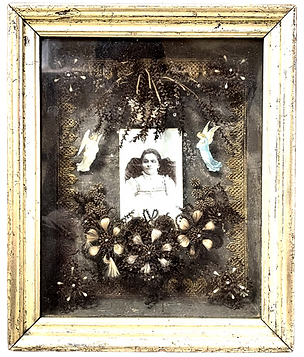


Personal collection of Jennifer Vaillant
Examples of Table works

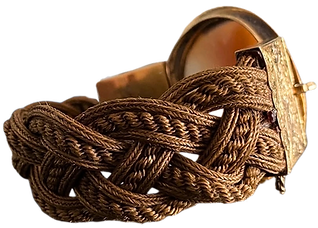


Photo courtesy of Sarah Nehama - used with permission

